
This past March, a pair of documentaries exploring the consequences of the 7 October 2023 attacks reached theaters just days apart. The first, titled October 8, centered on the “rise in antisemitism” on university grounds, on online platforms and on the public spaces” after militants killed more than 1,200 people in southern Israel, most of them civilians. This documentary, produced by a prominent celebrity, was broadly distributed by an independent distribution studio that has also handled a film about Donald Trump and a documentary on Jamal Khashoggi. Promotion for the film took place on mainstream programs, and it eventually earned more than $1.3m domestically, a significant sum for a documentary with political themes.
The other film, The Encampments, encountered greater obstacles. A documentary on campus protests against Israel’s retaliatory destruction of the Gaza Strip, partly centered on activist a key figure – who was later detained by Immigration and Customs Enforcement for his activism – got no support from famous TV hosts. Its limited theatrical run at a New York theater led to intimidation attempts, an act of property damage in the cinema entrance and removal of ads online. That it was released at all – and made $80,000 in its debut weekend, a notable achievement for the specialty box office – is thanks to a new distribution company, an emerging, Palestinian-American founded film funding and release firm started by brothers the Ali brothers to help films with Palestinian perspectives reach audiences they typically cannot, in a market that has historically overlooked or marginalized such stories.
Is a ‘chilling effect’ preventing Hollywood from tackling controversial documentaries?
The two documentaries evince the distinct environments for Israeli and Palestinian narratives in the United States – one concentrated and often backed by more mainstream institutions, the other fractured and more ad hoc, yet growing. The two-year anniversary of the 7 October attacks highlights this disparity even more – this weekend marks the limited release of The Road Between Us, a documentary tracking a retired Israeli general’s efforts to save his son’s family from militants on 7 October. A gripping thriller-like story of survival, trauma and mourning that omits the subsequent fatalities of at least 66,000 Palestinians in retaliation, this documentary received endorsement from celebrities and won the People’s Choice Award for best documentary at a major film festival. American release rights were rapidly acquired by a media company.
It’s difficult to get any hot-button, politically challenging film funded, much less distributed in the United States, particularly during the second Trump administration. But films featuring Palestinian perspectives, or films challenging the narrative of a authority that has used the tragedies of October 7th into a weapon of war defending an internationally recognized genocide in the region, have found it especially challenging, sometimes impossible, to connect with viewers. “I have never produced a film about Palestine that’s ever been distributed,” said one director, the director of Coexistence, My Ass!, a film about an comedian from Israel reexamining her past as “the literal poster child for the peace efforts between Israelis and Palestinians” in the aftermath of the widespread devastation of Gaza.
After a successful festival circuit, the director, who is of Lebanese and Canadian descent, had aspirations for a release agreement for their documentary. “We thought that there could be a possibility that Coexistence could break through just based on the subject’s distinct outlook – it’s such a unique way of looking at the situation,” the creator said. But agreements fell through; the team finally chose a self-release strategy beginning soon, handled by the identical firm that arranged another film’s self-release earlier this year. The other movie, a searing documentary by an collaborative group about long-standing struggles to fight against occupation in a Palestinian village, won a Oscar award under difficult circumstances for outstanding documentary; shortly after, local settlers violently attacked a co-director, who was then detained by soldiers allegedly mocking the award. It remains unavailable for streaming in the United States but made more than $2.5m at the American theaters (making it the top-earning of the Oscar-nominated documentaries this year).
‘We must act’: The firm distributing Palestinian films others avoid
A separate movie, All That’s Left of You, a grand narrative on three generations of a Palestinian family forced from their home in 1948, also sought distribution after a strong festival run, but ran into concern from distributors over the “content theme”. “We had high hopes that one mainstream distributor would agree to release it,” said the Palestinian American director. One conversation with an unnamed company ended, according to the filmmaker, with a rejection, citing an overloaded schedule. “That’s exactly what they told another Palestinian film that debuted recently at a film festival. It all feels like fear of controversy,” she said.
The truth, according to Watermelon co-founder, is that “there are not a lot of distributors that are going to support Palestinian films”. Large streaming platforms have avoided involvement. But a prominent studio recently purchased the global streaming rights to a series called “Red Alert”, a four-part scripted series partly produced by an Israeli production fund, which depicts the October 7th events on Israel that, per the logline, “turned southern Israel into a war zone, challenging human decency and forging heroism through chaos”. The studio CEO touted the series as proof of the firm dedication to narrative art through creative quality and accuracy”. And another platform secured the American rights for One Day in October, a dramatized show based on first-hand accounts of the incident that will debut on its second anniversary.
At the same time, “I don’t think a single Palestinian film has ever gotten wide release in the US”, said the filmmaker, who has since formed her own release firm, Visibility Films, in response to the obstacles. “No one’s really been willing to assume the chance on proving that these films could be seen widely.”
“It’s unfortunate that we have not received that same support,” said the co-founder. “None of our movies has been picked up by a mainstream streamer.” Nevertheless, “the sector is clearly changing”, he said, pointing to the recent commitment signed by more than 3,900 influential industry personalities to avoid collaboration with Israeli cinema organizations “associated with severe human rights issues” against Palestinians, noting: “But it seems, sadly, like the streaming platforms are not following suit.” (A number of famous individuals were among those who endorsed a criticism calling the pledge a “source of falsehoods”; several cited the country’s Oscar entry of a film titled “The Sea”, a movie concerning a Palestinian boy who tries to visit the beach for the first time but is denied entry at a checkpoint. Notably, Israel’s version of the Oscars is under threat of funding cuts after The Sea received the highest honor.)
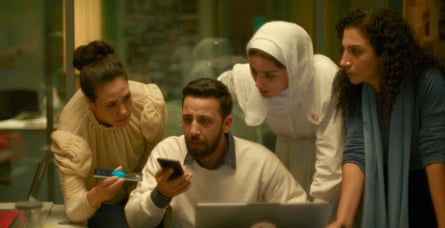
An emerging trend of Palestinian-led, challenging films is finally beginning to crest even without major corporate backing – Watermelon agreed to release All That’s Left of You, Jordan’s official submission to the Academy Awards, which will begin its limited theatrical release in the coming year; well-known stars came on board as producers. The company also represents Palestine’s official Oscar submission, multi-generational story Palestine 36, and is a producer on another documentary, which received critical acclaim and a significant prize at Venice; this movie, which recreates the death of a young child in Gaza with her real voice, will be distributed in Europe by a sales company, and has {yet to find|not


